
战狼
Exclusive: Brazilian soybean industry expects historically high export volumes to China: association_我的网站

一 |
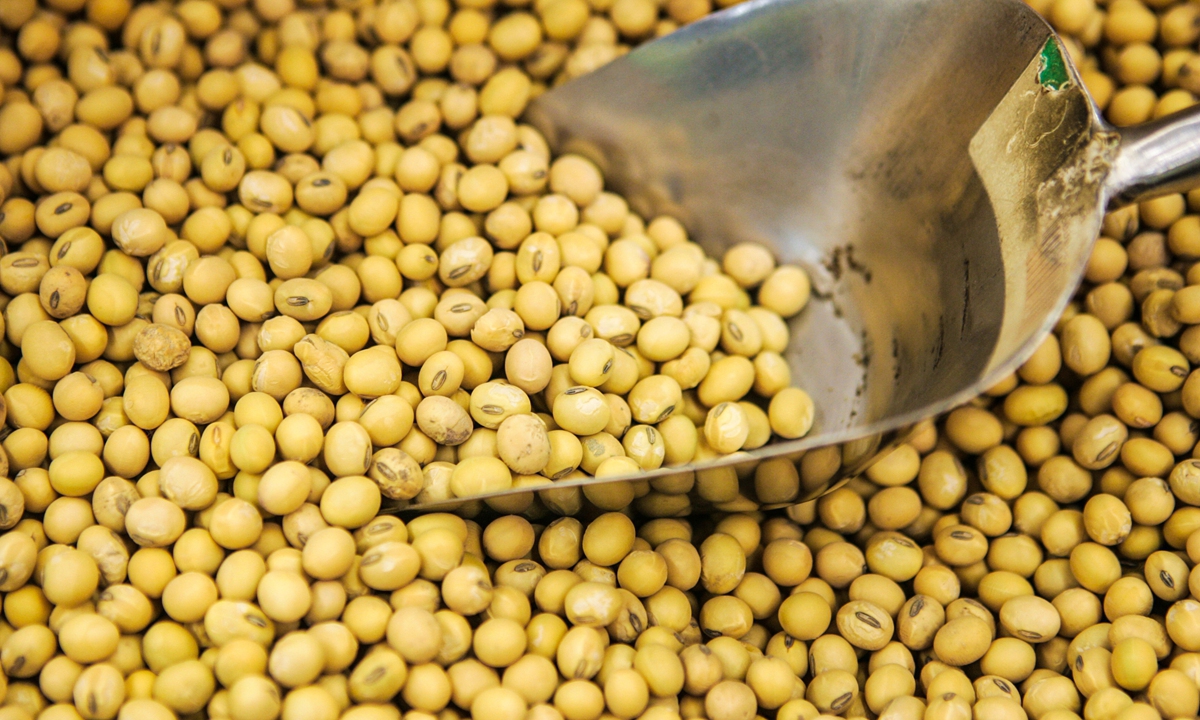
China continues to be the leading destination for Brazilian soybeans, and the Brazilian soybean industry wants to further deepen this relationship, expecting historically high volumes in the coming months, the Brazilian Association of Soybean Growers (Aprosoja Brasil) told the Global Times on Friday.
Brazilian soybean exports to China have remained very strong. China imported 12.08 million tons of soybeans from Brazil in June, up 13.7 percent year-on-year, while imports from the US fell 20.9 percent year-on-year to 1.27 million tons, according to data from the General Administration of Customs.
China imported 34.75 million tons of soybeans from Brazil during the period, up 9.1 percent year-on-year, according to Aprosoja Brasil. "Based on arrivals and customs clearance in China, there was clear growth," the association said.
According to the official data platform Brazilian Comex Stat, which records shipments at origin, 48.32 million metric tons were destined for China from January through June, largely unchanged from 48.41 million metric tons during the same period in 2025.
The difference between the two datasets mainly reflects timing and methodological differences between the recording of departures, cargoes in transit, arrivals and customs clearance.
Aprosoja Brasil said that the broader economic conclusion is the same: "Trade flows remained historically strong, China continued to be the leading destination for Brazilian soybeans, and Brazil's total soybean exports reached a first-half record of 69.57 million metric tons."
For farmers, strong export volumes help support the marketing of the crop, although record exports do not automatically mean record farm margins, said the Brazilian industry association.
China is the world's largest soybean importer. Imported soybeans are mainly used for oil production and animal feed. In terms of trading partners, China mainly imports soybean-related products from Brazil, the US, Argentina, Uruguay and Canada.
Brazil ranks among the world's leading soybean producers and exporters, with China being its largest export market for soybeans, according to the Xinhua News Agency.
Commenting on the significance of the Chinese market, Aprosoja Brasil said "China is absolutely strategic to Brazil's soybean industry," citing data showing that in 2025, China purchased 85.4 million metric tons, representing approximately 79 percent of all Brazilian soybean exports.
The two countries also have a highly complementary trade relationship. For Brazilian farmers, Chinese demand provides scale, market liquidity and greater capacity for long-term planning, said the Brazilian soybean industry association. For China, Brazil offers large, competitive and reliable supplies, as well as a crop calendar that complements production in other supplying countries.
Previously, policy shifts, such as US unilateral tariff measures, have caused disruption for US soybean farmers and other agricultural producers, Lü Xiang, research fellow at the Chinese Academy of Social Sciences, told the Global Times.
At the same time, China has been diversifying imports, including from Brazil and Argentina, to reduce risks from trade uncertainty, according to Lü.
Aprosoja Brasil noted that this partnership should not be seen merely as a temporary consequence of trade disputes involving third countries. Instead, it is a structural and mutually beneficial relationship, based on the complementarity between Brazil's production capacity and China's large demand for food, animal feed and protein, the industry group said.
Looking ahead to the soybean trade for the rest of the year, Aprosoja Brasil said that they are positive, while having a prudent mindset. Brazil has completed the harvest of a record soybean crop of approximately 180.6 million metric tons, and Brazilian soybean exports are expected to reach 116.3 million metric tons in 2026, which would also be a record, the association said.
"Brazil therefore has sufficient supply to continue serving the Chinese market strongly in the coming months... We expect historically high volumes, although not necessarily growth every single month, because soybean trade is seasonal and Northern Hemisphere supplies become more prominent during the second half of the year," it said.
。
据中国驻印尼大使馆网站5月19日消息,5月18日,中国驻印尼大使陆慷及夫人陈悦离任回国。
印尼外交部礼宾司副司长马拉多纳,中国驻东盟大使侯艳琪,中国驻印尼使馆公使周侃等到机场为陆大使夫妇送行。
连日来,陆大使通过各种方式向印尼各界和友好人士,以及在印尼中资企业代表、媒体和华人华侨等分别辞行。
此前,据中国驻印尼大使馆网站,5月12日,中华人民共和国驻印度尼西亚共和国特命全权大使陆慷辞行拜会印尼当选总统、国防部长、大印尼行动党总主席普拉博沃。
5月12日,陆慷大使在社交平台“X”(原推特)账户上发文说:“离任之际,同印尼当选总统、国防部长、大印尼行动党总主席普拉博沃阁下依依惜别。”
图片来源:中国驻印尼大使陆慷在社交平台“X”(原推特)账户发文截图
据中国驻印尼大使馆网站介绍,2022年2月22日,陆慷大使抵达印尼履新,出任第十三任中国驻印尼大使。
陆慷,男,1968年5月生于江苏南京市,公共政策硕士。
1996-1999 中国常驻联合国代表团随员、三秘
2001-2006 外交部军控司二秘、副处长、处长
2008-2010 外交部国际司参赞、副司长,中国亚太经合组织高官
2015-2019 外交部新闻司司长、外交部发言人

二 |
Current article:http://by9.wenwancaomohenenqiongpangshun.bond/ax0/hitewn9.html
Published on:18:51:09